Contents
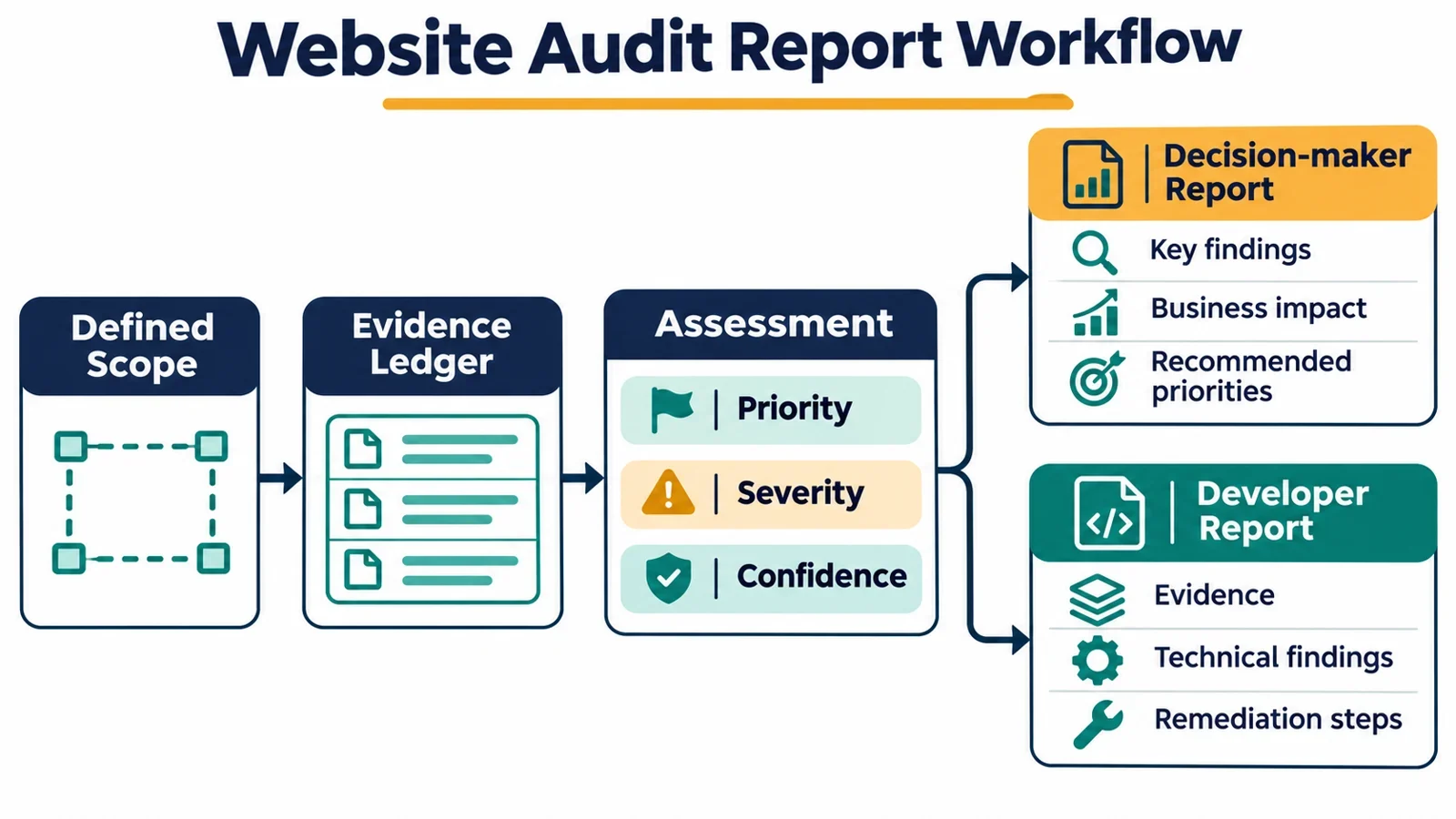
A website audit report becomes most useful when it separates what was checked from what was concluded, and when it speaks clearly to both decision-makers and the people who will implement changes. This article outlines a practical workflow for beginners: agree on scope in writing before collecting data, maintain an evidence ledger so every observation can be traced back to raw material, structure the report in layers for different audiences, and score issues using priority, severity, and confidence as separate dimensions. It does not promise traffic increases, ranking improvements, or specific recovery timelines, because those outcomes depend on search engines, user behavior, and factors outside an auditor’s control.
Scoping the Engagement and Setting Boundaries
A website audit begins with a written agreement that fixes the boundaries of the engagement before any data collection takes place. Defining scope protects both the auditor and the client by making explicit what will be examined, what will not be examined, and what the final deliverable will cover. Without this agreement, it is easy to drift into testing environments, third-party properties, or pages outside the client’s control, producing observations that cannot be acted upon and claims that cannot be traced to authorized work.
The core components of an audit scope document include allowed origins, a defined page sample, an observation window, explicit exclusions, and agreed deliverables. Allowed origins specify the canonical domains, subdomains, or URL prefixes that auditors may inspect. For example, if a client operates www.example.com and shop.example.com, the scope should state whether both are included or only one. Staging sites, development mirrors, password-protected areas, and third-party domains embedded in pages should be listed as exclusions unless the client explicitly authorizes their testing.
The page sample describes how representative pages are chosen. Auditors might select high-traffic landing pages, key conversion funnels, category templates, and a random sample of deeper pages. The sample should be large enough to reveal patterns but small enough to permit detailed manual review within the agreed timeframe. The observation window fixes the dates or rolling period during which evidence is captured. Because website content, headers, and configurations can change, findings should be tied to the exact date and time they were observed so clients understand what was current when the audit was performed.
Exclusions are just as important as inclusions. Content managed by external vendors, third-party analytics scripts, embedded social widgets, and linked partner sites may behave differently from the client’s own infrastructure. If these are excluded, the report should say so plainly so decision-makers do not assume full-site coverage.
Deliverables define what the client receives at the end, such as a prioritized findings list, an evidence ledger, an executive summary, and remediation recommendations. The scope should also state what the audit will not promise. Auditors should avoid guaranteeing traffic increases, ranking improvements, or specific uptime outcomes, because those depend on search engine behavior, competitor activity, and infrastructure outside the auditor’s control.
Scoping is a planning step, not a substitute for verification. It does not guarantee that every page is accessible, that every server responds, or that every identified issue is reproducible after the observation window ends. Clients should treat the scope as the authorization for the work to follow and confirm any changes to domains, pages, or timelines in writing before additional testing begins.
Collecting Defensible Evidence with an Evidence Ledger
Before a client sees any conclusion, an auditor should be able to point back to the exact material that produced it. This section explains how to maintain an evidence ledger that makes every observation independently verifiable and keeps reporting honest, traceable, and defensible.
What an evidence ledger does
An evidence ledger is a running record created during data collection, not after the report is written. Each observation receives one record with a stable identifier, a timestamp, the source of the check, the raw material captured, and the observation derived from it. Because the ID remains fixed, anyone reviewing the report can connect a conclusion to its underlying data without relying on memory or vague descriptions such as "checked on several pages."
The purpose is not to publish every raw file to the client. It is to ensure that if a stakeholder asks how a finding was reached, the auditor can retrieve the exact captured evidence and explain the observation conditions. This separation between raw evidence and interpreted finding also prevents conclusions from drifting as new checks are added.
Stable identifiers and timestamps
Each ledger entry should use a stable ID format that does not change if the entry is reordered, copied into a report, or referenced in a follow-up email. Examples might combine a category prefix with a sequential number, such as SEC-001, PERF-007, or ACCESS-012. The ID should remain attached to the observation wherever it appears, including in executive summaries, technical appendices, and remediation tickets.
Timestamps record when the check was performed, not when the report was finalized. A page may change between the audit window and delivery, so the timestamp anchors the finding to a specific moment. If a client later disputes an issue because the page now looks different, the ledger shows what was observed and when.
Capturing response bodies and raw material
For web checks, useful raw material can include HTTP status codes, response headers, rendered HTML, console output, network waterfall data, screenshots, and tool output files. The exact content depends on the check type. A security-header check might store the headers returned by the server, while a performance check might store timing metrics and resource sizes.
Raw material should be preserved in its original form as much as possible. Converting everything into a rewritten summary loses information that may matter later, such as the exact wording of a header or the sequence of loaded scripts. Storing files with names that include the stable ledger ID makes it easier to match evidence to findings without opening every file.
From evidence to observation
A ledger entry should distinguish between what was captured and what the auditor concluded from it. The raw material belongs in the evidence field. The observation belongs in a separate conclusion field. This separation makes it possible to re-evaluate the same evidence under a different scoring rule without re-collecting data.
For example, if a tool captures a page response time of four seconds during the observation window, the ledger records that timing value as raw material. The auditor then writes the observation, such as "page load exceeded the agreed performance threshold during the sampled check." If the threshold changes later, the raw timing evidence remains valid, and only the interpretation needs updating.
Making observations independently verifiable
Independent verification means another qualified person can use the ledger ID, timestamp, and raw material to reach the same observation without asking the original auditor for clarification. To support this, each entry should record enough context to reproduce the check conditions: the URL or origin tested, the tool or method used, the sample page or section, and any relevant environment details such as device class or connection profile.
The ledger should also record exclusions. If a page was sampled but omitted from the final analysis because it returned an error or required authentication, that decision belongs in the ledger. Omitting failed checks without recording them creates a misleading impression that every sampled page passed.
Using the ledger in client reporting
Client reports can reference ledger IDs instead of embedding long technical descriptions in the main narrative. A high-level summary might state that several issues were found in the security-headers category, then direct the reader to the technical appendix where entries SEC-001 through SEC-009 list the specific domains, headers checked, and observed responses.
Developers implementing fixes benefit from the same traceability. A ticket created from ledger entry PERF-007 can include the raw timing evidence, the observed condition, and the timestamp, giving the implementer a starting point without needing to re-run every check from scratch.
Boundaries to keep in mind
An evidence ledger documents what was observed under specific conditions. It does not guarantee that an issue exists at all times, that it will persist after the observation window, or that fixing it will produce a particular traffic or ranking outcome. Traffic and ranking depend on many factors outside the audit, including search-engine behavior, competitor activity, and user demand.
Similarly, the ledger does not validate that a tool is accurate in every environment. Tool outputs should be treated as evidence collected during the engagement, not as permanent proof of a site condition. If a client needs ongoing verification, repeat checks should create new ledger entries with new timestamps rather than assuming the original evidence still applies.
Readers planning an audit should confirm which tool outputs are acceptable as evidence for their client’s requirements, what retention period applies to raw files, and whether the client expects to receive the ledger itself or only the interpreted report.
Structuring the Report for Two Different Readers
A professional website audit report works best when it is organized in layers rather than as one long document addressed to everyone at once. Decision-makers and developers typically read for different purposes, and mixing their needs can bury either the business context or the implementation details.
The top layer should serve the decision-maker. This section can summarize what was audited, what was found, and what should happen next, without assuming technical expertise. It is useful to include an executive summary, a short list of prioritized findings, estimated effort or complexity where supported by the engagement scope, and recommended next steps. If tool outputs are referenced, they should be described in plain language, with conclusions separated from raw metrics so the reader can see what the evidence supports and what remains an inference.
The second layer should serve the developer or technical implementer. This section can contain the evidence ledger identifiers, page URLs, observed headers or status codes, screenshots or raw response excerpts where permitted, and specific locations in the codebase or configuration where changes may be appropriate. Keeping technical specifics in a separate appendix or clearly labeled section allows the implementer to act without requiring the client’s business stakeholder to interpret every detail.
Report navigation matters because both readers may use the same file at different times. A table of contents, stable section headings, and cross-references from executive findings to technical evidence make it possible for a developer to trace a recommendation back to its source. Where an observation includes uncertainty, that limitation should be stated explicitly rather than presented as a confirmed defect.
Practical structure might include an executive summary, prioritized issue list, methodology and scope notes, evidence ledger references, and technical implementation notes. The exact order can vary, but the separation between high-level priorities and implementation specifics should remain visible.
Readers should confirm with the client which report formats are acceptable before delivery, since some organizations require PDF, HTML, or a white-labeled report layout. No particular output format, turnaround time, or price should be assumed from the audit topic alone; these terms belong in the written engagement agreement.
Separating Priority, Severity, and Confidence
A website audit becomes actionable only when each observation carries three independent labels: severity, priority, and confidence. Beginners often collapse these into a single rating such as "high," which obscures whether an issue is important, urgent, or merely suspected. Keeping them separate lets decision-makers understand operational impact while developers know what to schedule and how much verification remains before treating a finding as settled.
Severity describes the operational impact of an issue if it remains unresolved. It answers how seriously the problem could affect users, site availability, data integrity, search visibility, or compliance. A broken checkout form generally has higher severity than a missing image alt attribute because it can block revenue directly. Severity does not by itself determine when work happens; it establishes the potential consequence of inaction.
Priority describes the chronological order in which issues should be addressed. It considers severity alongside effort, dependencies, client business cycles, and resource availability. A high-severity issue requiring a vendor contract or platform migration may be scheduled after a lower-severity issue that can be fixed in minutes and unblocks other work. Priority is therefore a scheduling decision, not a restatement of how bad an issue is.
Confidence describes the level of verification completed for an observation. It reflects whether the finding is based on repeated reproducible evidence, a single observed occurrence, an indirect signal, or an unverified assumption. A confidence label should accompany every issue so readers know which conclusions are ready for implementation and which require further testing before changes are made. High confidence does not mean high severity, and low confidence does not mean the issue is unimportant.
These distinctions prevent common reporting errors. A report that labels every issue "critical" makes triage impossible. A report that confuses severity with priority may push low-effort fixes aside while delaying high-impact work. A report that omits confidence can lead developers to implement changes based on weak evidence, wasting time and possibly introducing new problems.
An audit workflow can capture all three dimensions in a compact scoring table. Each row should include an observation identifier from the evidence ledger, a plain-language description, severity rating, priority rank, confidence level, and the evidence IDs supporting the finding. Keeping evidence identifiers attached to confidence ratings lets clients and developers trace a conclusion back to the raw material without relying on memory or re-running the entire audit.
Confidence should be revisited as verification progresses. An observation initially marked "low confidence" because it appeared only once in a sample may move to "high confidence" after reproduction across multiple pages, browsers, or time periods. Likewise, a finding marked high confidence based on one tool’s output may drop if a second independent check fails to reproduce it. These changes should be recorded in the report rather than silently editing the original rating.
Client communication benefits from plain-language definitions for each scale. Instead of using unexplained labels such as P1 or L3, the report can state what each level means in operational terms, such as "blocks core transactions," "affects secondary pages," or "cosmetic only." For confidence, terms such as "verified by repeated observation," "observed once," and "indirect signal only" give readers a concrete basis for judging how much trust to place in each recommendation.
Traffic or ranking outcomes should not be promised as part of severity or priority. Audit findings can identify conditions that may influence search performance or user behavior, but they cannot guarantee specific traffic changes, ranking positions, or revenue improvements. The report should frame recommendations as risk reduction and quality improvement rather than outcome commitments.
A final review should ask whether every priority decision can be explained in terms of severity, effort, dependencies, and timing; whether every issue has at least one evidence ledger ID; and whether every confidence label reflects verification actually completed rather than assumed. If any answer is no, the item returns to evidence collection or scoring before the report is released.