Audit workflow
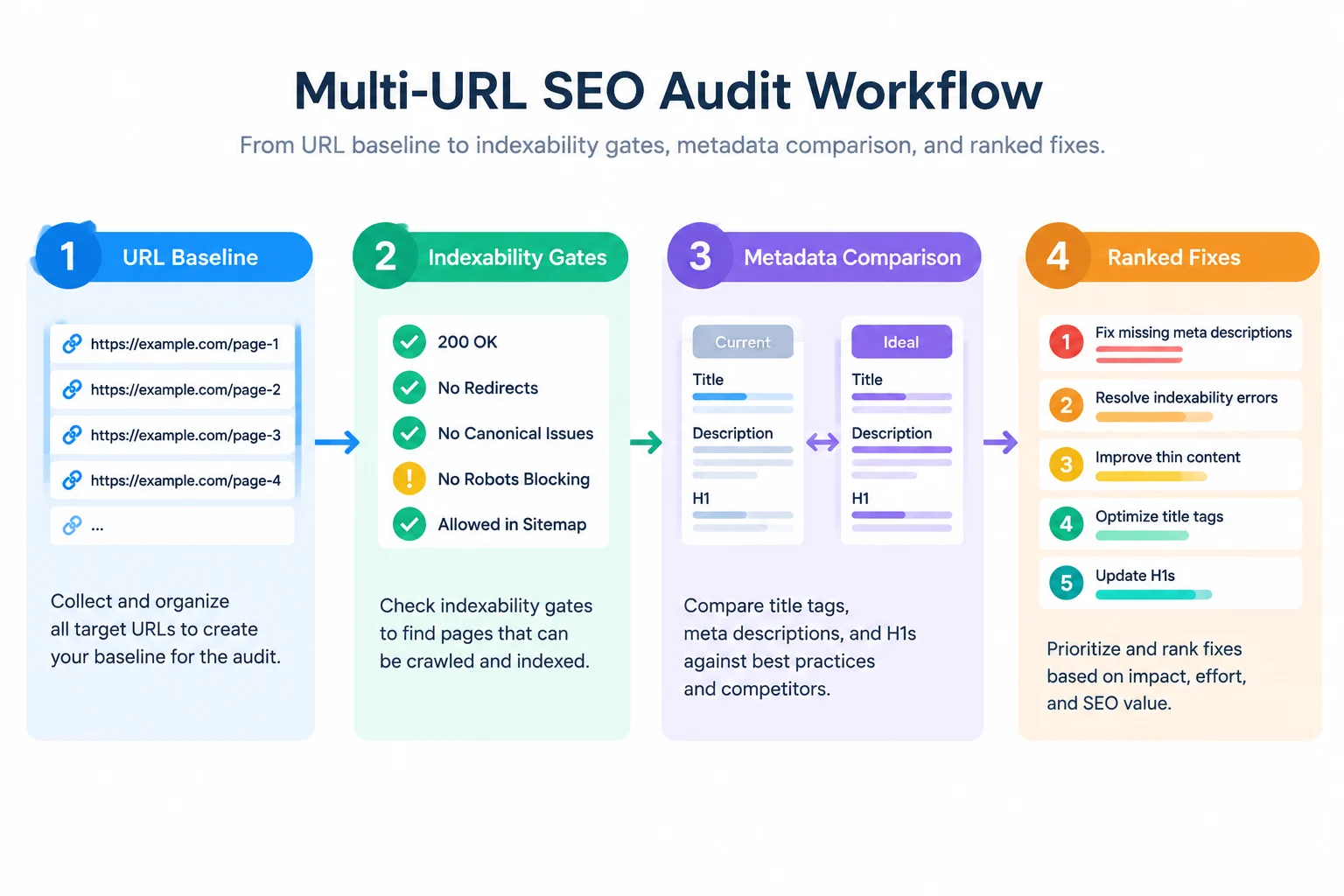
A multi-URL audit is a prioritization exercise, not a site-wide checklist. The goal is to find the metadata and indexability defects that matter most across a defined URL set, separate observations from conclusions, and produce a ranked fix list with owners and verification steps. This workflow treats crawlability and indexability as gates before metadata optimization, compares titles, descriptions, H1s, and canonicals across templates, and checks whether JavaScript changes what bots receive. It also states tool boundaries clearly: page-level checks can inspect server-returned HTML, status, headers, performance signals, responsive layout, and snapshot uptime, but they do not prove search index status, rankings, or traffic impact.
Audit scope and URL set definition
Start by defining the URL set and recording a baseline before changing anything. Do not treat every URL as equally valuable. Build the set from the sitemap, internal links, analytics, paid landing pages, and known templates, then group URLs by template and business role: home, category, product, article, location, support, legal, paginated, faceted, and parameter variants. Include high-traffic and high-value pages, plus a stratified sample of each template. Mark intentional exclusions, such as staging URLs, private pages, or thin variants, so they are not later mistaken for defects.
The baseline should record the exact URL, final URL, HTTP status, canonical, meta robots, X-Robots-Tag if visible, robots.txt access, sitemap membership, title, meta description, H1, template, owner, traffic bucket, and the date and user agent used. Save the raw server-returned HTML for evidence. This baseline is what makes before-and-after verification possible and prevents teams from arguing about whether a page changed.
Use a ranked defect list rather than a generic health score. Every finding should say what is broken, which URLs or templates are affected, why it matters, and how it will be verified. That keeps the audit tied to decisions instead of a dashboard number.
Crawl and indexability gates
Crawlability and indexability are pass-or-fail gates. Review them before optimizing titles or descriptions. A page with a broken status code, a redirect loop, a robots.txt block, a noindex directive, or a conflicting canonical is not ready for metadata polish. Gate checks should cover: 5xx errors, unexpected 4xx errors, redirect chains, final URL mismatches, robots.txt disallow rules, sitemap inclusion, meta robots noindex, X-Robots-Tag noindex, canonical targets, and duplicate URL variants.
Treat noindex and canonical exclusions as intentional only when there is evidence: the page is private, transactional, thin, duplicative, or intentionally excluded from search. A commercial landing page that is linked from navigation, included in the sitemap, and receives traffic is more likely to be a defect. Check business intent, internal links, sitemap presence, analytics, and the page’s role in the funnel before labeling it.
Duplicate URL variants are a gate issue because parameters, case differences, trailing slashes, and tracking links can create many similar URLs. That can waste crawl capacity and make full indexing harder. Normalize the URL inventory, identify parameter patterns, and decide whether to canonicalize, redirect, block, or leave them. Record the decision and owner, because a canonical that conflicts with a noindex or a redirect chain is still a defect even if each rule looks reasonable alone.
Cross-URL metadata comparison
Compare metadata across URLs, not just page by page. Extract title tags, meta descriptions, H1s, and canonicals into a table with URL, template, status, and evidence. Then look for missing, duplicated, truncated, boilerplate, or conflicting values. Bulk review should catch missing titles, duplicated titles, truncated titles, missing H1s, multiple H1s, boilerplate meta descriptions, and canonicals that point to the wrong URL or conflict with robots directives.
Group findings by template and by similarity. Exact duplicates are easy to flag. Near-duplicates need normalization and clustering: strip brand suffixes, location names, product IDs, and common boilerplate, then compare the remaining patterns. A category template that produces the same meta description for every page is a template-level content defect, not fifty separate copy problems. A product template that repeats the title across variants may indicate duplicate or low-quality content across URLs.
For each URL, record whether the canonical is self-referencing or cross-referencing, whether it matches the final URL, and whether it conflicts with noindex. For titles and descriptions, record the pattern and the likely cause: missing field, empty CMS value, truncation, global boilerplate, or localization issue. The output should be a comparison matrix with defect type, affected URLs, template, severity, and suggested owner. That matrix becomes the input to prioritization and fix batching.
Bot HTML versus rendered HTML
Where JavaScript can inject metadata, compare the no-JavaScript server-returned HTML with the rendered DOM. Fetch the page as a bot-like client, save the raw HTML, then render it with JavaScript and compare title, meta description, canonical, robots meta, H1, main content, and internal links. A title that exists only after rendering is a different risk from a title that is missing in both versions. A canonical injected by JavaScript can conflict with the server-returned canonical and confuse the intended signal.
Use this diff at scale by sampling templates and high-traffic URLs first, then expanding if the pattern appears. Record the observation precisely: server HTML title present, rendered title different or canonical absent in server HTML, injected by script. Do not automatically conclude that search engines will fail to see the metadata. Treat JavaScript-only metadata as a risk that needs verification, especially when it affects indexability directives or canonical signals.
State the limits. A lightweight multi-URL metadata check can review titles, descriptions, canonicals, robots directives, and heading structure in server-returned HTML, but it cannot prove JavaScript content, robots.txt behavior, or search index status. Those require separate checks and external evidence. The audit should separate what was observed in the page fetch from what is inferred about crawling and indexing.
Prioritization by traffic risk and effort
Rank issues by traffic risk, indexability severity, template reach, fix effort, owner, and confidence. A practical model is a weighted score, not a precise prediction: traffic risk 0-5, severity 0-5, template reach 0-5, confidence 0-3, minus effort 0-5. The exact weights should be agreed with the client, because a high-revenue product page and a support article do not carry the same business risk.
When analytics are incomplete, estimate traffic risk with proxies: internal link count, navigation inclusion, sitemap priority, paid landing usage, conversion role, historical traffic, sales value, and template reach. Mark low-confidence estimates clearly. A page with no analytics but many internal links and a clear commercial role may still outrank a low-value page with perfect data.
Estimate effort by work type. A robots.txt change, canonical template fix, or CMS field default may be a small developer task. Rewriting descriptions across hundreds of pages is a content task. JavaScript rendering fixes may require engineering and QA. Assign an owner for each fix: dev, content, SEO, analytics, or product. Each fix should state what is broken, the affected URLs, expected impact, effort, owner, and verification method. The result should be a ranked defect list with owners, not a generic health score.
Fix batches and verification
Batch fixes by root cause or template, not by individual URL. If one CMS template emits a duplicate meta description, fix the template once and verify the affected URLs. If a robots.txt rule blocks a whole section, change the rule and re-check the section. If a canonical logic error affects product variants, fix the logic and test representative variants. Batching reduces repeated work and makes ownership clearer.
Before deployment, freeze the URL set and baseline. After deployment, re-run the same checks on the same URLs. Verify status codes, final URLs, robots.txt access, noindex directives, canonicals, titles, descriptions, H1s, and the server-versus-rendered diff. Check that the sitemap still includes the intended URLs and that redirects do not create new chains. For each fix, record the before value, after value, date, and evidence.
Traffic verification should be cautious. Monitor organic sessions, impressions, clicks, conversions, and crawl or index reports where available, but do not claim causation from a short window. Use a control group of unchanged templates when possible. If a change risks traffic loss, define a rollback plan. The verification method should be written into the fix ticket before work starts, so the team knows what evidence will close the issue.
Reporting and client handoff
A white-label report should make the method and limits visible. Start with scope: URL count, templates, date, user agent, and exclusions. Then summarize the highest-risk findings, the prioritization rationale, and the recommended fix batches. Put the full URL matrix in an appendix. Use before-and-after evidence for fixes that have been deployed, and label planned fixes as planned rather than verified.
Separate observations from conclusions. An observation is canonical points to a different URL or title is missing in server HTML. A conclusion is this likely prevents the page from being indexed as intended. The second statement needs evidence or should be marked as a hypothesis. Disclose tool boundaries: page fetches inspect server-returned HTML, uptime checks are snapshots, and search index status is outside a page fetch. Do not present a score as proof of search performance.
For client handoff, include an executive summary, top fixes with owners and effort, assumptions, open questions, intentional exclusions, and verification dates. State that search index status, rankings, and traffic impact require external confirmation, such as Search Console URL Inspection and Page Indexing reports or Bing Webmaster Tools. White-label reporting packages the evidence; it does not replace the evidence.
Module mapping and tool boundaries
Map each enabled module to a specific part of the workflow and state what it cannot prove.
url-status-check: confirms status codes, redirects, and final URLs. It does not prove index status, canonical intent, or traffic impact.seo-audit: reviews titles, descriptions, canonicals, robots directives, and heading structure in server-returned HTML. It does not inspect JavaScript-rendered content, robots.txt, or search index status.performance-check: provides page performance signals. It does not prove ranking causation or field performance for every user.security-header-check: reviews security headers. It is not a full security audit or penetration test.uptime-check: records snapshot uptime. It is not continuous SLA monitoring and does not prove crawlability.responsive-preview: previews responsive layouts. It does not replace real-device testing or prove SEO outcomes.white-label-report: packages findings for clients. It does not create evidence or validate search index status.
The audit conclusion should be limited to what the modules observed. Use official query entry points for external verification, such as Search Console URL Inspection and Page Indexing reports, Bing Webmaster Tools, and robots.txt and sitemap documentation. A module can support a finding; it should not be described as proof of rankings, indexing, or revenue impact.